We know what A4 or A5 refer to, but what would an Aπ sheet of paper look like? This is what we wondered with a few of my friends, and this led to the world's first piper!
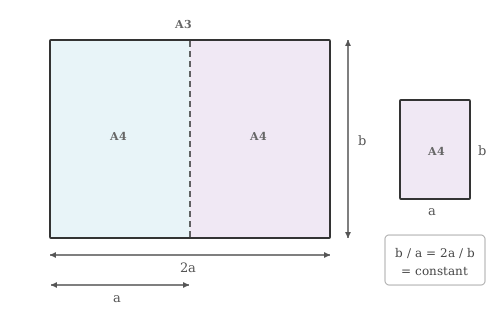
All A series papers (ISO 216) have the same height/width ratio and they have an interesting property:
This means that we can easily find the ratio between width and height of the sheet.
$ω=\frac{b}{a}$ $\Leftrightarrow 2a=ω\cdot b$ $\Leftrightarrow 2a=ω\cdot\left(a\cdotω\right)$ $\Leftrightarrow 2a=aω^2$ $\Leftrightarrow \boxed{ω=\sqrt{2}}$
which checks with the official standard.
Knowing that each time we add one to the index, the size is divided by two, we can easily find the general formula from the width from the size of an A0 sheet of paper:
$w\left(n\right)=w_0\cdot ω^{-n}$ $\boxed{w\left(n\right)=84.1\cdot \sqrt{2}^{-n}}$
This is the general formula that we need to find w(π): w(π) = 28,31 $w\left(\pi\right)=84.1\cdot\sqrt{2}^{-\pi}=28.31$
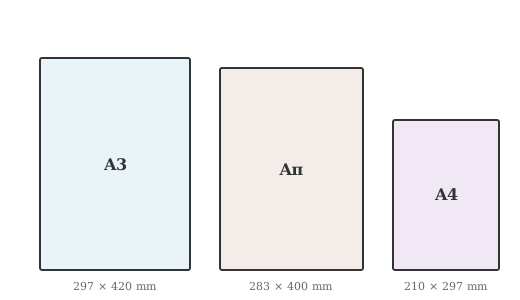
This makes sense as the width should indeed be between A4's 21cm and A3's 30cm and is far closer to A3's width, as expected.
This led to the creation of the world's first (as far as I know) Aπ paper measuring 28.3 by 40 cm!
Happy pi day!!!